
Chronique et interview par François Kärlek
CHRONIQUE FR
Belnejoum, belnejoum, voilà un nom surprenant aux sonorités peu courantes. Doux comme un loukoum.
Et pourtant, une fois n’est pas coutume, je vais vous parler de Black Metal, style musical qui n’en est pas à sa première contradiction (on pense au Black Metal Chrétien par exemple…).
Ici, point de religion exacerbée (car que l’on parle de Satan ou Dieu, cela revient un peu au même au final), mais des concepts philosophiques, appuyés sur le personnage de Zarathoustra, prophète perse, maître de la sagesse, plus proche de la figure mythologique qu’historique.
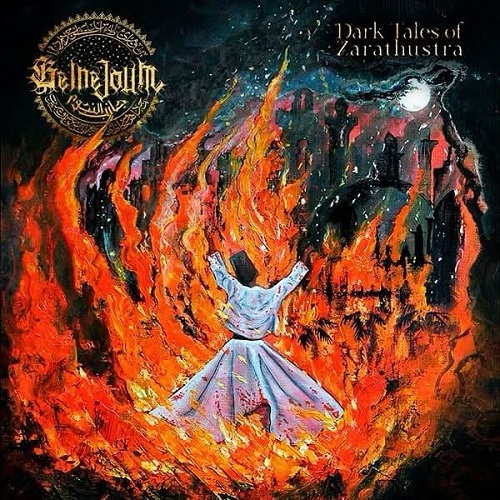
Sauf que la version de Zoroastre par Belnejoum est nourrie de folie et violence, le vieux sage devient destructeur, tel un derviche tourneur maléfique et fou contemplant la ville qu’il vient de livrer aux flammes, mise en image sur le magnifique artwork (peint à l’huile, pas à l’IA dégueulasse) de Joanna Maeyens.
Rassurez-vous, nul besoin d’avoir fait une thèse pour s’immerger dans l’univers de cet album, les textes étant très symboliques et nourris des expériences et l’imaginaire personnels de Qaswad, son géniteur, en particulier sur les 2 morceaux les plus sensibles et proches de la musique classique dans leur inspiration : “Tower of Silence”, abordant le thème du deuil, et « In their Darkest Aquarium”, le thème de l’enfermement physique (et mental par extrapolation).
Les passerelles entre musique classique et Metal, en particulier symphonique et nourri de violons et clavier, sont nombreuses. On peut citer Children of Bodom, Marduk, Enthroned, Hollenthon, the CNK, Imperial Triumphant etc… On ne sera donc pas étonné de retrouver sur le morceau « In their Darkest Aquarium”, des emprunts au « Carnaval des animaux » de Camille Saint-Saëns. Et j’avoue que l’intro et outro de « Tower of Silence » pourraient tout à fait être issues d’œuvres classiques aussi.
Ces inspirations classiques et la construction de la musique, à tiroir et complexe harmoniquement, reposent sur le fait que tout a été composé au piano. Cela se ressent totalement sur l’album, et constitue une passerelle dans l’esprit avec les meilleurs albums de Dimmu Borgir (SBD, PEM, DCA), composés par Mustis. Cette impression de découvrir un Dimmu moderne et nourri d’inspiration orientale est renforcée par la production de Fredrik Nordstrom : batterie foisonnante et clinique, claviers hollywoodiens, guitares massives. L’héritage des norvégiens est pleinement maîtrisé et assumé, et il donne à l’album une grande ampleur sonore et un arrière-gout nostalgique pour les auditeurs les plus anciens.
Le résultat musical est vraiment fabuleusement riche, alternant en fureur et douceur, la brûlure des passages de blast d’inspiration Death Technique (avec Kolias de Nile aux fûts), et guitares incisives alterne avec le baume salvateur de solos de Ney (Flûte perse), chant féminin envoûtant, violons pompeux… Fil conducteur de l’œuvre, le chant de Qaswad (égyptien expatrié aux US) est très spécifique et ambigu, ni death ni black, très narratif et souvent empreint de douleur.
J’en appelle ici aux deux pièces maîtresses de l’album : “Prophet of Desolation” et « Upon the Mortal Blight » pour vous convaincre. Nous avons ici eux blocs de 10 min sans qu’aucune lassitude ne pointe à l’horizon, un exercice de haute voltige brillamment accompli grâce à une écriture cohérente, ambitieuse, et inspirée. On sent ici une grande maturité des compositions, dont certaines occupaient depuis 10 ans l’esprit du maître de cérémonie.
Mon morceau préféré, et sans doute le plus abordable pour découvrir l’album, demeure “Tower of Silence” avec ses passages intro/outro sans batterie, l’intégration d’instruments traditionnels sur de la double pédale ternaire supersonique, un changement de tonalité dramatique sur le refrain, un chant possédé, une structure alambiquée et progressive, le morceau ne se répétant jamais. Emphatique, superbement triste, à découvrir avec son clip.
Réunissant des musiciens hors pairs et un chef d’orchestre à la hauteur, Belnejoum est à la fois une œuvre superbe et une énorme surprise de 2025, sous forme de coup de cœur instantané auquel on garde une place au chaud pour nos tops de fin d’année.
ENTRETIEN FR
Bonjour Qaswad, que signigie Belnejoum? Et que signifie le texte du logo?
Il signifie « Par les étoiles » ou « Du côté des étoiles ». Il fait référence à une dimension où vivent des démons. Il est tiré de l’univers d’Ahmed Khalid Tawfik, écrivain d’horreur égyptien. Le texte à l’intérieur du cercle est le même mot en arabe. Le texte autour du cercle est un sortilège tiré d’un ancien livre de magie arabe intitulé « Shams Al Ma’arf ». Plus précisément, il s’agit d’un sortilège de puissance.
Pourquoi avoir choisi Zarathoustra comme thème central de cet album ? Que représente ce personnage pour toi ?
Le concept initial de l’album mettait en scène un jeune sorcier qui cherche à se venger de son village situé quelque part en Europe. Mais plus j’avançais dans l’album, plus je me suis dit qu’il fallait d’explorer une autre option, située dans les temps anciens en Perse.
Je voulais un personnage qui présente une déchéance en allant de la posture la plus sainte à la plus impie. Zarathoustra représentant à mes yeux une des figures religieuses orientales les plus respectables, il correspondait parfaitement à mon thème.
De plus, nous connaissons l’histoire telle qu’on nous l’a racontée, qu’elle soit vraie ou fausse, ce qui laisse possible l’interprétation.
Quel est le morceau le plus personnel de l’album ? Pourquoi ?
« Tower of Silence », je l’ai écrite à ma mère alors que nous étions séparés depuis de nombreuses années.
Vous composez la musique au piano, comment fais-tu la transition du piano au black metal ?
Pour moi, le piano est un moyen de communiquer les mélodies. Normalement, après la composition, je répartis les extraits des morceaux entre les différents instruments et je les intègre dans un logiciel. Ensuite, je continue à les modifier jusqu’à obtenir une première version acceptable.
En étape suivante, nous commençons à enregistrer les instruments et nous améliorons constamment le processus créatif à travers les différentes voix. Tous les musiciens contribuent à l’édifice en faisant des propositions.
A-t-il été facile de recruter les musiciens de Nile et Fleshgod Apocalypse ?
En ligne tout simplement, et oui, cela s’est fait naturellement. Leurs contacts sont disponibles et c’est agréable de travailler avec eux car ils sont à la fois très professionnels et décontractés. In fine, ce qu’ils apportent à la musique est tout simplement génial.
La production évoque le Dimmu Borgir des années 2000, pourquoi ce choix ?
J’aime ce son, très typé, et c’est vraiment ce que je voulais pour ce premier album.
Mais je pense explorer d’autres sonorités dans les prochaines étapes.
Es-tu satisfait de la réception critique de l’album ?
Oui, je suis très honoré.
Quel est l’avenir de Belnejoum ? Quels sont tes projets ? Conserveras-tu la même production pour les prochaines sorties ?
Nous travaillons actuellement sur le deuxième album. J’ai apporté quelques modifications à la section guitare et nous avons désormais Morfeus (ex-Limbonic Art, ex-Mayhem) en plus d’Ehab. Cela devrait vraiment propulser le groupe vers des horizons plus sombres. Le futur album sera je pense bien supérieur au premier, les compositions étant nettement plus sombres et complexes. Pour information Belnejoum est le seul projet sur lequel je travaille.
Je suis certain que je continuerai toujours à travailler avec Fredrick Nordstrom, tout en explorant une production plus spécifique à Belnejoum.
Quels sont tes 3 livres, 3 films et albums (Metal ou pas) préférés ?
Livres :
La Maison des morts – Dostoïevski
Le Maître et Marguerite – Mikhaïl Boulgakov
100 ans de solitude – Gabriel Garcia Marquez
Films :
Silence – Martin Scorsese
Parasite – Bong Joon Ho
Princesse Mononoké – Hayao Miyazaki
Musique
Classique :
Concerto pour piano n° 2 de Rachmaninov
Tout Chopin
Tout Tchaïkovski
Metal :
Emperor – Anthems to the welkin at dusk
Limbonic art – Moon in the Scorpio
Dimmu Borgir – Spiritual black dimensions
Behemoth – Demigod
Le mot de la fin est pour toi.
Merci pour votre soutien, j’apprécie vraiment la démarche. J’ai passé la majeure partie de ma vie à jouer de la musique dans mon salon (je ne faisais de la musique que pour moi-même). Partager mes idées avec Belnejoum est une expérience très spéciale, elle signifie beaucoup pour moi.
REVIEW ENGLISH
Belnejoum, belnejoum, that’s a surprising name with unusual sounds. Sweet as Turkish delight.
And yet, for once, I’m going to talk to you about Black Metal, a musical style that’s not at its first contradiction (think of Christian Black Metal, for example…).
Here, there’s no excessive religion (because whether we’re talking about Satan or God, it all comes down to the same thing in the end), but philosophical concepts, based on the character of Zarathustra, a Persian prophet, master of wisdom, closer to the mythological figure than to the historical one.
Except that Belnejoum’s version of Zoroaster is fueled by madness and violence; the old sage becomes destructive, like an evil and mad whirling dervish contemplating the city he has just consigned to the flames, depicted in the magnificent artwork (painted in oil, not with disgusting AI) by Joanna Maeyens.
Rest assured, there is no need to have done a thesis to immerse yourself in the universe of this album, the lyrics being very symbolic and nourished by the personal experiences and imagination of Qaswad, its creator, in particular on the two most sensitive pieces and close to classical music in their inspiration: “Tower of Silence”, addressing the theme of mourning, and “In their Darkest Aquarium”, the theme of physical (and mental by extrapolation) confinement.
There are many connections between classical music and metal, particularly symphonic music with violins and keyboards. Examples include Children of Bodom, Marduk, Enthroned, Hollenthon, the CNK, Imperial Triumphant, etc. It’s no surprise, then, to find borrowings from Camille Saint-Saëns’ Carnival of the Animals on the track « In Their Darkest Aquarium. » And I admit that the intro and outro of « Tower of Silence » could easily be taken from classical works as well.
These classical inspirations and the construction of the music, layered and harmonically complex, are based on the fact that everything was composed on the piano. This is fully felt on the album, and provides a spiritual bridge to the best Dimmu Borgir albums (SBD, PEM, DCA), composed by Mustis. This impression of discovering a modern Dimmu, nourished by oriental inspiration, is reinforced by Fredrik Nordstrom’s production: abundant and clinical drums, Hollywood-style keyboards, massive guitars. The Norwegians’ heritage is fully mastered and embraced, and It gives the album a great sonic breadth and a nostalgic aftertaste for older listeners.
The musical result is fabulously rich, alternating between fury and sweetness, the burning of Death Technique-inspired blast passages (with Kolias form Nile on drums), and incisive guitars alternate with the healing balm of persian flute (Ney) passages, captivating female vocals, and sumptuous violins… The common thread of the work, the vocals of Qaswad (an Egyptian expatriate in the US) are very specific and ambiguous, neither death nor black, very narrative, and often tinged with pain.
I call upon the album’s two master pieces: « Prophet of Desolation » and « Upon the Mortal Blight » to convince you. Here we have two 10-minute blocks without any weariness on the horizon, a high-flying exercise brilliantly accomplished thanks to coherent, ambitious, and inspired writing. We feel here a great maturity of the compositions, some of which have occupied the thoughts of the mastermind Qaswad for 10 years.
My favorite track, and arguably the most accessible one to discover the album, remains « Tower of Silence, » with its subtle intro/outro passages, the integration of traditional instruments on a supersonic ternary double pedal, a dramatic key change on the chorus, possessed vocals, a convoluted and progressive structure, the song never repeating itself. Emphatic, superbly sad, to be discovered with its video.
Bringing together peerless musicians and a perfect conductor, Belnejoum is both a superb work and a huge surprise for 2025, an instant favorite that we’re saving a warm spot for our end-of-year toplist.
INTERVIEW ENG
Hello Qaswad, what does Belnejoum mean? And what is the meaning of the text on the logo?
It means “By the stars” or “The side of the stars”. It refers to a dimension where demons live. It’s from the universe of an Egyptian horror writer – Ahmed Khalid Tawfik. The text inside the circle is the same word in Arabic. The text around the circle is a spell from an ancient Arabic magic book named “Shams Al Ma’arf”. Specially a spell of might.
Why did you choose Zarathustra as the central theme of this album? What does this character mean to you?
The initial album concept was about a young wizard who seeks vengeance on his village somewhere in Europe. But the more I got into the album, I decided to explore another option. The ancient times in Persia really fit the theme. I wanted a character that descended from the most holy to the unholy.
So Zarathustra fits the theme. End of the day, we know about the history as what we been told, regardless of its true or not. I think Zarathustra symbolism is what I think of the most likely nature of holy figures.
What is the most personal piece on the album? Why?
“Tower of silence”, I wrote it to my mother as we are separated for many years.
You compose the music on the piano, how did you make the transition from piano to black metal?
For me the piano is a way to communicate the melodies, normally after it’s composed, i write a list of the track sections between different instruments and it gets into a software. Then I keep modifying till it’s acceptable first draft. Then we start working on recording instruments and there is none stop improvements along the way. And improvements from all the participating musicians.
Was it easy to hire the musicians from Nile and Fleshgod Apocalypse?
Online and yes it’s not difficult. Their contacts are available and they are lovely to work with. It’s easy in terms of “they are very professional and easygoing”. But what they add to the music is pure awesomeness.
The production evokes the Dimmu Borgir of the 2000s, why did you make this choice?
I like the sound, I think I will explore more sounds in the next stage but for the first album this is what I wanted.
Are you satisfied with the critical response to the album?
Yes, I am super honoured.
What is the future of Belnejoum? What are your projects? Will you keep the same production on future releases?
Currently we are working in album 2. I made some changes in the guitar section and now we have Morfeus (ex Limbonic art, ex Mayhem) this in addition to Ehab. This should really take album 2 into darker space. Album 2 will be a far superior product than album 1, the compositions are far darker and more complex. Belnejoum is the only project I am working on.
I am certain that I will still want to work with Fredrick Nordstrom but I genuinely want to explore more specific Belnejoum sound.
What are your 3 favourite books, 3 films, and music albums ?
Books :
The house of the dead – Dostoievsky
The master and margarita – Mikhail Bulgakov
100 years of solitude – Gabriel Garcia Marquez
Films :
Silence- Martin Scorsese
Parasite- Bong Joon Ho
Princess Mononoke – Hayao Miyazaki
Music :
Classical:
Rachmaninoff Piano Concerto no.2
Anything by Chopin
Anything by Tchaikovsky
Metal:
Emperor – Anthems to the welkin at dusk
Limbonic art – Moon in the Scorpio
Dimmu Borgir – Spiritual black dimensions
Behemoth – Demigod
The final word is for you…
Thanks for the great support, I really appreciate it. Being a bedroom musician most of life (only playing/making music to myself). This feels very special and it means a lot to me.
 Satan Bouche Un Coin